
Contents:
- Why Flowers Fit Hanukkah So Well
- The Basics: What Makes Hanukkah Flowers Different
- Blue and White, and Why They Appear Everywhere
- Symbols to Choose and Symbols to Avoid
- Flowers That Work
- A Note on Dyed Blue Flowers
- A Real-Life Scene: Choosing for a Host
- Hosting Etiquette: What Guests Should Know
- Hosting Etiquette: What Hosts Should Think About
- The 2026 Hanukkah Calendar and Your Flower Timeline
- Choosing Arrangements by Occasion
- For the Hostess Gift
- For the Family Table
- For a Large Gathering
- For Sending to Someone Far Away
- For Office or Client Gifts
- Where to Find Hanukkah Flowers
- Intermediate Level: Matching Flowers to the Eight Nights
- Advanced Nuances: Interfaith Families, Colleagues and Cultural Sensitivity
- Interfaith Households
- Workplace Etiquette
- Degrees of Observance
- Sustainability
- Caring for Hanukkah Flowers Over Eight Nights
- Pairing Flowers with Other Hanukkah Gifts
- Hanukkah Flowers vs. Christmas Flowers: A Commonly Confused Choice
- Flowers for Children and Pet-Friendly Homes
- Small Rituals That Make Flowers Part of the Celebration
- Three Table Setups You Can Copy
- The Classic Blue and White Table
- The Modern Minimalist Table
- The Family Buffet
- Common Mistakes to Avoid
- Budget Notes
- Hanukkah Flowers FAQ
- Is it appropriate to bring flowers to a Hanukkah dinner?
- What colors are best for Hanukkah flowers?
- When should I send flowers for Hanukkah in 2026?
- Can I send Hanukkah flowers to a coworker?
- How long do Hanukkah flowers last?
- A Brighter Table
More than two thousand years ago, according to tradition, a small band of Maccabees reclaimed the Temple in Jerusalem and found only a single day’s worth of pure oil for the menorah. The lamp burned for eight days. That story is why Hanukkah lasts eight nights and why homes glow with candlelight every December. It is also why a thoughtful gift for a Hanukkah host leans toward warmth and light, not tinsel and holly. If you are choosing Hanukkah flowers, shopping for blue and white arrangements or trying to get the hosting etiquette right, this guide walks you through each decision like a friend who has done it before.
Why Flowers Fit Hanukkah So Well
Hanukkah is a holiday of home, family and small daily rituals. Candles are lit each evening, meals are shared, children spin dreidels and relatives drop by across the week. Flowers fit into that rhythm naturally. They are not part of any required ritual, so there are no rules you can break, but they add a layer of warmth to a table that already has candles, latkes and gifts on it.
There is also a practical reason. Hanukkah lasts eight nights, which means your arrangement will be on display for a long stretch. A bouquet that holds up for a week or more is worth far more than one that fades after three days.
The Basics: What Makes Hanukkah Flowers Different
The most important thing to know is that Hanukkah is not “Jewish Christmas.” It is a distinct holiday with its own history, traditions and symbols. That shapes what looks and feels right on a Hanukkah table.
Blue and White, and Why They Appear Everywhere
The blue-and-white palette is a modern association. It echoes the Israeli flag and the stripes of a traditional prayer shawl. Neither color is a religious requirement, but both have become the unofficial colors of the season, from decorations to wrapping paper to table linens. A bouquet in blue and white fits right in, and it signals that you chose the flowers for this holiday, not a generic December occasion.
Symbols to Choose and Symbols to Avoid
- Welcome: stars, silver and gold accents, candle-like shapes, pale blue and ice-white flowers.
- Skip: red-and-green Christmas palettes, pine garland, ornaments, holly, poinsettias and anything labeled “holiday” without context.
Evergreen foliage on its own is not offensive, but the combination of red berries, pine and ribbon looks like a Christmas arrangement, and that is not what you want on a Hanukkah table.
Flowers That Work
- Blue: hydrangeas, delphinium, iris, muscari, eryngium (sea holly), blue thistle and larkspur.
- White: roses, ranunculus, anemones, lisianthus, tulips, stock, freesia and paperwhites.
- Silver-green accents: dusty miller, silver dollar eucalyptus, olive branches and lamb’s ear.
A bouquet with two whites, one blue and a silver-toned foliage looks cohesive and refined. Add one or two larger focal flowers, such as white roses or hydrangeas, and the arrangement has structure.
A Note on Dyed Blue Flowers
True blue is rare in nature. Many “blue” roses are white roses dyed with food-safe coloring, which can look striking but sometimes stains the water or fades unevenly. Natural blue options such as hydrangeas, delphinium and iris deliver the color without dye, and they usually last longer. If you buy dyed flowers, ask the florist how they hold up and keep the vase out of sunlight.
A Real-Life Scene: Choosing for a Host
Picture a common situation. A coworker invites you to her family’s Hanukkah dinner on the third night. You have never been to one. You want to bring something but you are worried about getting it wrong. You decide against wine, since you are unsure of the family’s preferences, and against food, since you do not know about dietary rules. Flowers solve both worries. You choose a compact arrangement of white ranunculus, pale blue hydrangeas and silver eucalyptus in a simple glass vase. You deliver it that morning so that the host can place it before guests arrive, and you add a card that says, “Thank you for including me.” The host puts it on the sideboard next to the hanukkiah and mentions it all evening. That small act cost around $60, avoided every potential misstep and left a good impression.
The lesson is that flowers are a safe, warm, low-risk choice, especially when the details of a family’s observance are unknown.
Hosting Etiquette: What Guests Should Know
Good manners at a Hanukkah gathering come down to respect and curiosity. These practices help.
- Ask about timing. Candles are lit at nightfall, and many families wait to start the meal until after the lighting. Ask what time to arrive so you do not interrupt.
- Do not blow out or touch the candles. The hanukkiah is meant to burn down on its own, and the candles have a specific purpose.
- Bring a thoughtful, not extravagant, gift. Flowers, a book, a small dessert from a kosher bakery if you know the family keeps kosher or a game for the kids are all welcome.
- Check food customs before bringing a dish. Some households keep kosher, which governs ingredients and preparation. Flowers avoid the issue entirely.
- Follow the family’s lead. Join in the singing or the dreidel games if invited, and ask questions if you are curious. Most hosts enjoy explaining their traditions.
- Dress comfortably and festively. Smart casual is a safe baseline unless you are told otherwise.
- Send a short thank-you note afterward. A text or card the next day is appreciated.
Hosting Etiquette: What Hosts Should Think About
If you are the one hosting, flowers can anchor the table, and a florist like My Peonika can help you size the arrangement to the space. A few practical points make the setup easier and safer.
- Keep arrangements away from open flames. The hanukkiah burns for about 30 minutes each night. Place flowers at least a foot from the candles, never directly above or beside them, and avoid dried or highly flammable decorations.
- Choose low centerpieces. Guests should see each other across the table. Keep arrangements under 12 inches tall.
- Pick mild scents. Latkes, brisket and sufganiyot already have strong aromas, so skip heavily perfumed flowers.
- Coordinate with the table. Blue and white napkins, silver candlesticks and a white tablecloth make a clean base for a similarly toned bouquet.
- Plan a secondary arrangement. A small bouquet at the entry or on the sideboard welcomes guests and keeps the main table uncluttered.
The 2026 Hanukkah Calendar and Your Flower Timeline
Hanukkah follows the Hebrew calendar, so the dates shift each year. In 2026, the holiday begins at sundown on Friday, December 4, and ends at nightfall on Saturday, December 12. Check a Jewish calendar for your location if exact lighting times matter to you. Because the first night falls on a Friday evening, it overlaps with the start of Shabbat, and that affects your planning more than most people expect.
- Mid-November: Decide whether you are hosting, attending or sending a gift. Browse styles and set a budget.
- Late November: Place orders for large arrangements or multiple deliveries. This also avoids the Thanksgiving rush on December 1 and 2.
- Wednesday, December 2 to Thursday, December 3: Ideal delivery days for the first night. Flowers have time to open and be arranged before Friday.
- Friday, December 4: Deliveries should arrive by early afternoon at the latest. Observant families begin Shabbat preparations well before sundown and may not accept deliveries afterward.
- December 5 to 11: Nights two through eight. Send a gift to a host, refresh the table arrangement or deliver flowers to a family you plan to visit.
- December 12: The holiday ends at nightfall. A thank-you note or flowers sent the next week is a lovely follow-up.
A useful rule: if the recipient observes Shabbat, avoid sending anything to arrive between Friday afternoon and Saturday night, and schedule around it.
Choosing Arrangements by Occasion
For the Hostess Gift
A compact vase arrangement, 8 to 10 inches tall, in white and blue with silver foliage. It is ready to display, easy to place and does not compete with the table. Expect to spend $50 to $90.
For the Family Table
A low arrangement in a shallow bowl or trough, using white roses, pale blue hydrangeas and silver accents. If you light candles at the table, choose a design with no tall elements nearby. Budget $75 to $140.
For a Large Gathering
A larger arrangement for a sideboard or entry, 24 to 30 inches tall, with delphinium, white stock, snapdragons and eucalyptus. For a big statement, larger bouquets from a specialist make sense. Budget $140 to $300.
For Sending to Someone Far Away
Choose a florist who understands the holiday and can deliver on a specific day. A card with a short Hanukkah greeting, such as “Wishing you a bright and joyful Hanukkah,” feels personal without assuming anything about the family’s practices.
For Office or Client Gifts
Neutral white arrangements with a touch of blue and silver. Avoid religious symbols unless you know the recipient’s preferences. A card that says “Happy Hanukkah” or “Warm wishes this season” is appropriate for those who celebrate.
Where to Find Hanukkah Flowers
The quickest way to avoid a generic holiday bouquet is to start with a shop that offers a dedicated collection. My Peonika’s hanukkah flowers page groups arrangements in the blue, white and silver palette, so you can compare sizes without wading through red-and-green designs. If you want to look at the full range, including larger pieces and other seasonal options, the main shop is easy to browse. The advantage of working with a local specialist such as My Peonika is that the flowers are built and delivered by the same team, which makes timing around Friday evening much simpler.
Intermediate Level: Matching Flowers to the Eight Nights
Some families like to refresh or add to their decor across the holiday. A simple scheme keeps it interesting without a big budget.
- Nights 1 and 2: The main arrangement goes up. Use your best bouquet here.
- Nights 3 to 5: Add a small posy at the entry or in a guest bathroom.
- Nights 6 and 7: Freshen with a few new stems, such as white tulips or snapdragons.
- Night 8: Traditionally the biggest celebration, with all eight candles plus the shamash burning. This is a good night for a final, larger flourish.
If gifts are exchanged on certain nights, a small bouquet can be part of a themed night, for example one night for books, one for games and one for flowers.
Advanced Nuances: Interfaith Families, Colleagues and Cultural Sensitivity
Interfaith Households
Many families celebrate both Hanukkah and Christmas, and their approach varies widely. Some keep the holidays separate. Others blend them with joy. When you are not sure, a neutral winter arrangement in white, silver and soft blue works for both. Avoid assuming how a family combines traditions.
Workplace Etiquette
If you are sending flowers to a colleague who celebrates, use a short, respectful greeting and avoid pairing it with Christmas gifts of the same style. A simple, tasteful arrangement shows you noticed their holiday. Do not make guesses about someone’s religion. Send Hanukkah wishes only when you know the recipient celebrates.
Degrees of Observance
Jewish families range from highly observant to largely secular, and their Hanukkah celebrations look different accordingly. Some host big dinners every night, while others light candles quietly. Flowers suit all of them, but timing and presentation should reflect the person you are sending them to. If you can, ask a mutual friend about their routine.
Sustainability
Choose natural blue flowers over dyed ones when you can, ask for compostable wrapping and skip floral foam. Because Hanukkah arrives when many flowers are out of season locally, look for responsibly grown stems and consider a potted plant, such as white paperwhites or a small orchid, that lives on after the holiday.
Caring for Hanukkah Flowers Over Eight Nights
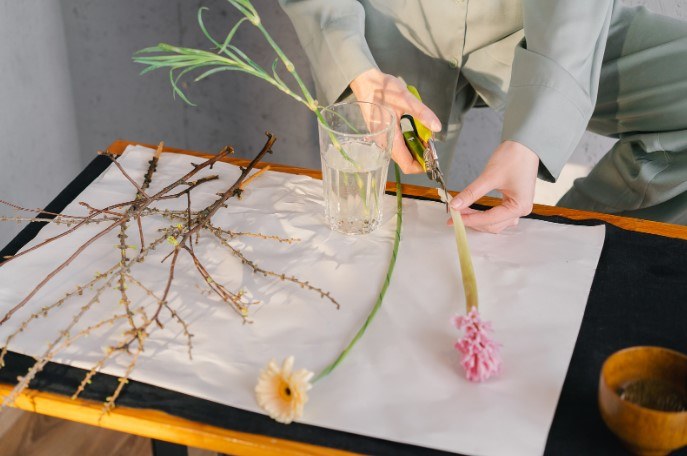
- Trim stems at an angle and remove lower leaves.
- Use a clean vase with fresh water and flower food.
- Change the water every two days, since the arrangement will be on display a long time.
- Keep it away from the hanukkiah, heaters and direct sunlight.
- Remove spent blooms promptly to keep the arrangement looking fresh.
- Hydrangeas drink heavily. Check the water level daily and mist the heads if they droop.
Pairing Flowers with Other Hanukkah Gifts
Flowers are a graceful gift on their own, but a small pairing can make them feel complete. Choose items that match the spirit of the holiday and the interests of the family.
- Gelt and sweets. Chocolate coins in blue and silver foil delight children. Check that the chocolate is kosher if you know the family keeps kosher.
- A dreidel or a family game. A set of wooden dreidels or a board game gives the family something to enjoy together across the eight nights.
- Books. A picture book about Hanukkah, or a cookbook with latke and sufganiyot recipes, suits both children and adults.
- Candles. Hanukkah candles are standard, and packs are inexpensive. A box in a decorative color makes a nice add-on, though many families already have a preferred brand.
- A handwritten card. Mention what you appreciate about the family. It is the most personal part of any gift.
When you assemble a combined gift, keep the flowers as the centerpiece and the extras small. A bouquet from My Peonika plus a bag of gelt and a note is easy to carry, easy to receive and unlikely to cause confusion about customs.
Hanukkah Flowers vs. Christmas Flowers: A Commonly Confused Choice
Shoppers sometimes assume that any December bouquet will do for either holiday. In practice, the two differ in meaningful ways.
- Palette: Christmas arrangements lean on red, green and gold. Hanukkah arrangements lean on blue, white and silver.
- Greenery: Pine, fir and holly dominate Christmas designs. Hanukkah designs favor silvery foliage such as eucalyptus, dusty miller and olive.
- Accents: Christmas arrangements use ornaments, ribbon and berries. Hanukkah arrangements keep accents minimal, sometimes with a star or a simple silver ribbon.
- Timing: Christmas peaks on December 24 and 25. Hanukkah moves each year, and in 2026 it begins on December 4, so you may be ordering during Thanksgiving week.
The practical takeaway is to order from a collection created for Hanukkah and avoid ordering a Christmas design and asking for substitutions. A specialist that curates separate seasonal collections, as My Peonika does, gets the palette and details right from the start.
Flowers for Children and Pet-Friendly Homes
Hanukkah gatherings often include children running between rooms and sometimes a family dog or cat. A few small precautions keep the flowers safe and the evening relaxed.
- Use a heavy, wide-based vase that cannot be tipped by a stray elbow.
- Choose low arrangements over tall ones.
- Avoid true lilies if cats live in the home, since even a bit of pollen can be dangerous.
- Remove any wire, picks or decorations that a small child could pull out.
- Keep arrangements out of reach of toddlers, especially near candles and glassware.
Small Rituals That Make Flowers Part of the Celebration
You can weave flowers into the holiday without adding to the to-do list. Some families let children place one stem in the vase each night, so by the eighth night the bouquet is full. Others set a small bud vase beside the hanukkiah as a quiet companion to the candles, well clear of the flames. A few use leftover blooms to decorate the dessert table or tuck a stem into each napkin. These tiny habits add meaning at almost no cost, and they give younger family members a way to take part.
Three Table Setups You Can Copy
The Classic Blue and White Table
Start with a white tablecloth and silver candlesticks. Add a low bowl of white roses, pale blue hydrangeas and silver eucalyptus down the center, with the hanukkiah at one end or on a nearby sideboard. Blue napkins and white plates complete the look. Keep the flowers under 10 inches and the candles clear of any foliage.
The Modern Minimalist Table
Use a bare wood table or a gray linen runner. Choose a single type of flower in one color, such as white tulips or pale blue delphinium, in three small glass vases of different heights. Add a handful of silver dreidels or gelt in a bowl for a quiet pop of color. The restraint looks intentional and leaves room for the food.
The Family Buffet
For a casual gathering, set the food on a side table and keep the flowers at the edges. A tall arrangement of delphinium, stock and eucalyptus at one end gives the buffet height, while small bud vases with a few white stems on the dining table keep conversation easy. This layout works well when guests drift between rooms and the main table is busy with plates.
Whichever setup you pick, test the arrangement in the room before guests arrive. Step back, check sightlines, confirm that nothing sits near a flame and trim any stems that look uneven. Ten minutes of adjustment at the start saves constant fussing during the evening.
Common Mistakes to Avoid
- Sending a Christmas-style bouquet. Red, green, pine and holly signal the wrong holiday. Ask for blue, white and silver.
- Delivering too late on Friday. With the first night on a Friday in 2026, evening deliveries may not be received by observant families.
- Placing flowers near the candles. Keep them at a safe distance from flames.
- Assuming everyone celebrates the same way. Keep greetings warm and neutral if you are unsure.
- Choosing strong scents. They clash with food and bother guests.
- Over-decorating. Too many symbols, such as stars, menorahs and dreidels in one arrangement, can feel cluttered. Choose one subtle accent.
- Bringing food without asking. If the family keeps kosher, an uninvited dish can create awkwardness. Flowers are safer.
- Waiting until the last minute. Popular blue flowers, especially hydrangeas and delphinium, can be harder to source in December.
Budget Notes
A small, thoughtful host gift typically runs $50 to $90. A table-sized arrangement for your own home falls between $75 and $140. Large entry or sideboard pieces start around $140 and rise to $300 or more. Delivery usually adds $10 to $25. To save money without losing impact, choose a monochrome white bouquet with a few blue stems and silver foliage, and put your budget into the container. A simple glass or silver-toned vase does as much for the look as extra flowers.
Hanukkah Flowers FAQ
Is it appropriate to bring flowers to a Hanukkah dinner?
Yes. Flowers are a welcome and low-risk gift, and they avoid questions about kosher food and dietary customs. Bring them in a vase or send them ahead.
What colors are best for Hanukkah flowers?
Blue, white and silver are the classic palette. Pale blue hydrangeas, white roses and silver eucalyptus are a dependable combination.
When should I send flowers for Hanukkah in 2026?
For the first night on Friday, December 4, deliver on Wednesday or Thursday. For other nights, deliver one to two days before the visit.
Can I send Hanukkah flowers to a coworker?
Yes, if you know they celebrate. Keep the card short and warm, and choose a neutral blue and white arrangement.
How long do Hanukkah flowers last?
With good care, most arrangements last 7 to 10 days, which comfortably covers the eight nights. Roses, hydrangeas and lisianthus are especially durable.
A Brighter Table
Hanukkah is about light, and good flowers add to it without taking over. Pick blue and white, keep the arrangement low and away from the flames, time your delivery around Shabbat and let the family’s own traditions lead. Do that and your bouquet will fit right in, whether it lands on a host’s sideboard or at the center of your own table. With the first night arriving on December 4, the best moment to choose is this week, and everything you need is at https://mypeonika.com/.
ARTICLE_HTML_END